
Why You're Still Exhausted After 8 Hours of Sleep: The Cortisol-Energy Connection
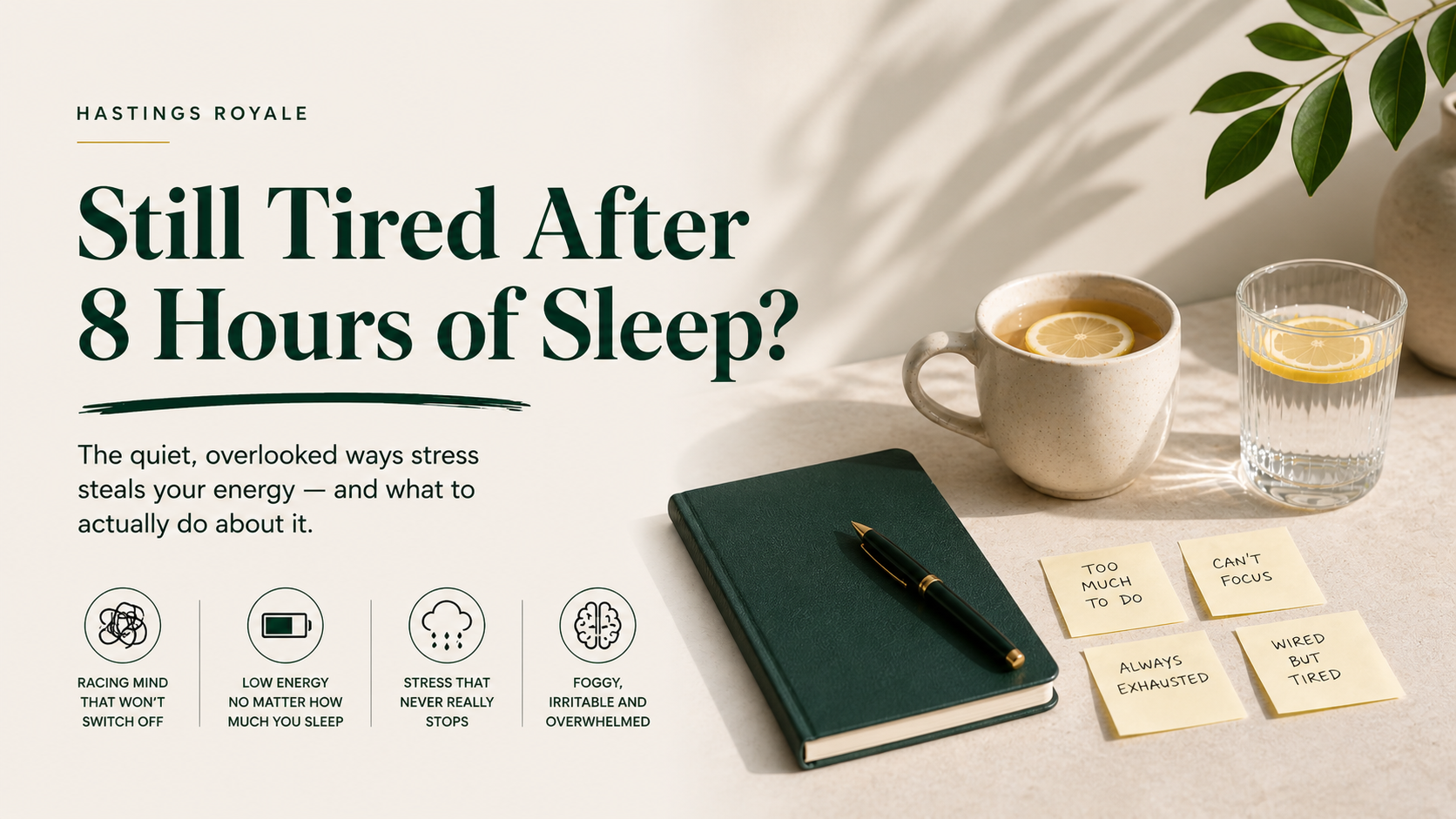
You sleep seven, maybe eight hours. You eat well. You train consistently. And yet you're still tired — not just physically tired, but the kind that sits behind your eyes and turns a regular Tuesday into something you just need to get through.
Here's what most wellness content won't say: you can be doing everything right and still be running on empty. Because the problem isn't your habits. It's something working beneath them — and it's called chronic stress.
Once you understand how stress actually drains you at a hormonal, cellular level, you can stop blaming yourself and start doing something real about it.
What the Wellness World Gets Wrong About Stress and Energy
✘: Stress only affects you if you feel stressed.
✔: Stress is biological before it's emotional. Cortisol — your primary stress hormone — can be dysregulated without you feeling overwhelmed. Even subtle, chronic low-grade stress creates an altered physiological baseline where exhaustion quietly becomes your new normal (Journal of Clinical Endocrinology & Metabolism, 2024).
✘: If you're sleeping 7–8 hours, your recovery is fine.
✔: Sleep duration and sleep quality are not the same thing. Cortisol disruption degrades the restorative depth of sleep — meaning you can log eight hours and still wake up with a depleted nervous system. Stress and sleep are bidirectionally linked, with cortisol affecting both your ability to enter deep sleep and the quality of recovery that follows.
✘: Burnout means you've hit a wall — you'll know when it happens.
✔: Burnout is a slow recalibration, not a sudden crash. Mental Health America (2025) identifies constant fatigue, difficulty focusing, irritability, and low-grade headaches as commonly missed signs — symptoms most people attribute to being busy, not burned out.
The Stress and Energy Symptoms You're Probably Misreading
Stress doesn't just make you anxious. It shows up as symptoms almost universally blamed on something else — poor sleep, not enough protein, overtraining, or simply not being a morning person.
Low morning energy is one of the clearest signals. Cortisol should naturally peak within the first hour of waking — the body's built-in ignition system. When HPA axis function is disrupted by chronic stress, this morning peak becomes blunted, leaving you foggy and reliant on caffeine just to reach baseline.
Then there are the patterns that feel personal but aren't: mid-day crashes regardless of what you ate, afternoon cravings for sugar or salt, and a wired-but-tired feeling between 9 and 11 pm — too exhausted to function, too activated to rest. These are cortisol patterns, not personality traits. Your body has been communicating through them all along.
How to Track What Stress Is Doing to Your Energy
Stress is notoriously difficult to self-detect. The most reliable tool you have is deliberate, consistent self-observation — pattern recognition with a purpose.
Morning energy score. Rate your energy out of 10 within 30 minutes of waking — before coffee — for two weeks. A consistently low score that doesn't improve with more sleep points to cortisol rhythm disruption, not sleep debt.
Afternoon slump timing. Note exactly when your energy drops and what preceded it. Stress-related crashes often follow mental load — back-to-back decisions, emotionally demanding conversations — not just physical exertion.
Evening activation pattern. Tired but restless between 9–11 pm? This is a hallmark of elevated evening cortisol — a pattern that reinforces poor sleep and keeps the cycle running.
The key insight here: you don't rest your way out of HPA axis dysregulation. You regulate your way out — through intentional, consistent practice that targets the stress response at its root.
Practical Ways to Reduce Stress's Hold on Your Energy
Anchor your mornings. Ten minutes of stillness — no phone, no news, no decisions — before the day starts protects the cortisol awakening response and sets a calmer hormonal tone for what follows. It doesn't require meditation experience. It requires intention.
Build deliberate recovery into your training week. Chronic stress combined with high training loads amplifies cortisol dysregulation. One or two lower-intensity sessions per week — where the goal is restoration, not output — directly supports HPA axis recovery.
Supporting your body with the right daily inputs matters too — especially when stress has been running the show.
Aether Electrolyte™ by Hastings Royale — Cortisol dysregulation affects aldosterone, the hormone governing sodium and fluid retention, meaning chronically stressed individuals often experience accelerated electrolyte depletion that compounds fatigue. Aether Electrolyte™ supports cellular hydration without sugar, stimulants, or artificial additives — making it a practical daily tool, not just a gym recovery product.
Seraya Hormonal Balance by Hastings Royale — For those experiencing disrupted cycles, mood instability, or persistent low energy driven by the hormonal cascade sustained stress creates, targeted adaptogenic support can meaningfully assist the body's own regulation. Seraya works with your hormonal system — building resilience at the root, not masking symptoms at the surface.
Protect one boundary per day. Identify one thing you can remove, delegate, or delay. Small, consistent boundaries reduce allostatic load incrementally — and produce measurable physiological change over weeks.
Your Energy Isn't the Problem — Your System Is Asking for Support
If you've been doing everything right and still feel exhausted, this is your permission to stop blaming yourself. The problem isn't your discipline or dedication. It's a system under pressure — one that needs regulation, not more effort.
Stress quietly reshapes your baseline until depletion feels like just how you are. But that baseline can shift back — with the right awareness, the right practices, and the right support.
References
Frontiers in Behavioral Neuroscience (2021) 'Mental Resilience and Coping With Stress'. Available at: https://www.frontiersin.org/journals/behavioral-neuroscience (Accessed: April 2026).
Journal of Clinical Endocrinology & Metabolism (2024) Review on chronic stress and allostatic load. Available at: https://academic.oup.com/jcem (Accessed: April 2026).
Mental Health America (2025) Burnout: Signs and Recovery. Available at: https://mhanational.org (Accessed: April 2026).
Psychoneuroendocrinology (systematic review) Cortisol, fatigue, and HPA axis dysfunction. Available at: https://www.sciencedirect.com/journal/psychoneuroendocrinology (Accessed: April 2026).