

Protein Obsession Is Hurting Your Health
Scroll through any fitness feed and you'll find the same scene: shaker bottles, meal-prep containers stacked in fours, and the relentless pursuit of the next 30-gram protein hit. The supplement industry loves it. Your muscles tolerate it. But quietly — one meal at a time — your carbohydrates, fats, and hydration are being crowded off the plate by the one macro that got famous.
Here's the uncomfortable truth: protein alone cannot build the body, the energy, or the performance you're after. Science has known this for decades. Yet inside the fitness and wellness community — where macros are tracked, progress photos are posted, and the next PR is always on the horizon — balance has become the first casualty of the protein wars.
Let's fix that. Below is what each of the four macronutrients actually does, why cutting any one of them short is costing you, and how to give your body the full system support it deserves.
1. Carbohydrates: Your Brain and Body's First Choice — Not the Enemy
Low-carb culture has done a remarkable job convincing people that carbohydrates are the villain in their wellness story. The reality? Your body disagrees — and loudly.
"Carbohydrates are an important dietary energy source and provide 4 kcal of energy per gram. Carbohydrate intake raises blood glucose levels and stimulates insulin secretion, promoting glucose uptake into tissues and glucose storage as glycogen. Additionally, carbohydrates play an important role in gut health and immune function." (Espinosa-Salas & Gonzalez-Arias, 2023)
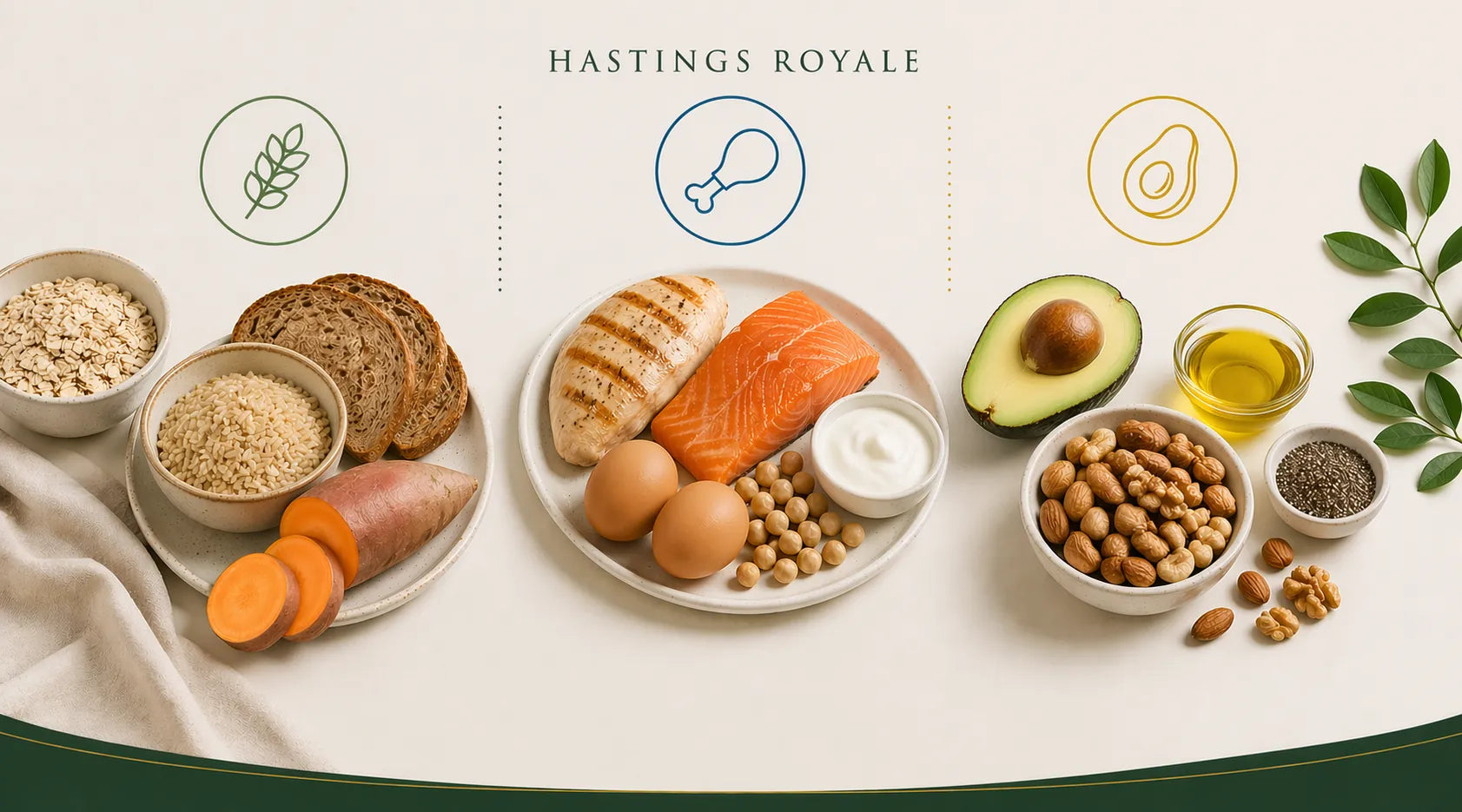
Whole-food carbohydrates — oats, sweet potato, fruit, legumes — deliver more than fuel. They carry fiber, phytochemicals, and micronutrients that protect against cardiovascular disease, type 2 diabetes, and certain cancers. A diet that glorifies protein at the expense of quality carbs isn't high-performance eating; it's an incomplete strategy. Practical step: anchor each meal with a palm-sized serve of whole-food carbohydrates alongside your protein source.
2. Protein: Powerful, But Not the Whole Story
Protein deserves its reputation. At 4 kcal per gram, it supplies the amino acids your muscles, enzymes, hormones, and immune system depend on. For anyone over 40, it's especially critical:
"Adequate dietary protein intake is important for maintaining lean body mass throughout the life span. In older adults, protein plays an important role in preventing age-related loss of skeletal muscle mass." (Cena & Calder, 2020)
But the current obsession tips into imbalance. Research published in the Journal of the International Society of Sports Nutrition (2024) found that protein supplementation is frequently overemphasized, with evidence showing diminishing returns beyond adequate intake — and a troubling neglect of the other macronutrients. Excess protein without sufficient carbohydrates and healthy fats can increase dietary acid load, strain kidneys in susceptible individuals, and crowd out the fiber and vitamins your gut and hormones need. The goal isn't maximum protein — it's optimal protein within a balanced framework.
3. Fats: The Unsung Architects of Hormones, Recovery, and Brain Function
Dietary fat has spent years as a nutritional scapegoat. Meanwhile, your hormones, brain, and every cell membrane in your body have been waiting quietly for you to come back.
"Lipids or dietary fats are the most energy-dense macronutrient and provide 9 kcal of energy per gram. In human physiology, lipids are essential for the production of sex hormones, maintenance of cellular structure, energy storage as body fat, regulation of body temperature, protection from physical trauma, and the absorption of fat-soluble vitamins A, D, E, and K." (Espinosa-Salas & Gonzalez-Arias, 2023)
Omega-3-rich unsaturated fats — found in fatty fish, avocado, nuts, and olive oil — are also linked to reduced cardiovascular risk and better control of systemic inflammation. For gym-goers and active individuals experiencing stubborn fatigue, slow recovery, or hormonal disruption despite training consistently, chronically low-fat intake is often the overlooked culprit. Practical step: include a thumb-sized serving of quality fat — avocado, a small handful of nuts, or cold-pressed olive oil — at least twice daily.
4. Water: The Fourth Macronutrient Nobody Counts — and Everybody Needs
Water is required in greater quantities than any other nutrient. It carries zero calories, and perhaps because of that, it rarely makes the highlight reel. Yet remove it and every other macronutrient becomes functionally useless.
"Water is essential for metabolism, substrate transport across membranes, cellular homeostasis, temperature regulation, and circulatory function." (Armstrong & Johnson, 2018)
The performance cost of ignoring hydration is real and measurable. Research has shown that even mild dehydration — a body mass loss of just 1–2% — significantly impairs cognitive function, physical performance, mood, and recovery (Popkin et al., 2010). That 3 pm brain fog you're blaming on a bad night's sleep? Often, it's dehydration wearing a disguise.
In South Africa's warm climate, especially across back-to-back training sessions or high-intensity competition weeks, water plus electrolytes becomes non-negotiable. Electrolytes — sodium, potassium, magnesium — govern fluid balance inside and outside your cells. Without them, water alone won't restore what hard training depletes. This is exactly the gap AETHER ELECTROLYTE™ was formulated to close: clean, evidence-based cellular replenishment built for athletes and active individuals who refuse to let recovery be the bottleneck.
Balance Isn't a Compromise — It's the Strategy
The science is consistent: macronutrient balance, not single-nutrient obsession, is what underpins metabolic health, sustained energy, hormonal harmony, and long-term performance (Carreiro et al., 2016). Every macronutrient plays a role that the others cannot replicate.
Protein builds. Carbohydrates fuel. Fats regulate. Water enables everything. Cut one, and the system pays the price — usually in fatigue, crashes, slow recovery, or hormonal disruption that's easy to misattribute and hard to reverse.
The shift worth making isn't dramatic. It's consistent, balanced, and grounded in how your body actually works: real food across all macronutrient groups, quality hydration throughout the day, and targeted supplementation when training demands outpace what your diet can deliver alone.
References
Armstrong, L.E. & Johnson, E.C. (2018). Water Intake, Water Balance, and the Elusive Daily Water Requirement. Nutrients, 10(12), 1928. https://doi.org/10.3390/nu10121928
Carreiro, A.L. et al. (2016). The macronutrients, appetite and energy intake. Advances in Nutrition, 7(4), 706–716. https://doi.org/10.3945/an.115.011650
Cena, H. & Calder, P.C. (2020). Defining a Healthy Diet: Evidence for the Role of Contemporary Dietary Patterns in Health and Disease. Nutrients, 12(2), 334. https://doi.org/10.3390/nu12020334
Espinosa-Salas, S. & Gonzalez-Arias, M. (2023). Nutrition: Macronutrient Intake, Imbalances, and Interventions. In: StatPearls [Internet]. StatPearls Publishing. https://www.ncbi.nlm.nih.gov/books/NBK594226/
Popkin, B.M., D'Anci, K.E. & Rosenberg, I.H. (2010). Water, Hydration and Health. Nutrition Reviews, 68(8), 439–458. https://doi.org/10.1111/j.1753-4887.2010.00304.x